
Weekly Cyber Intel Brief | 2026-11-06
GPT-6 Cyber highlights dual-use vulnerability research, a Chainalysis customer-data incident expands, and SonicWall exploitation prompts patching.
PressContact Blog · 3 minute read
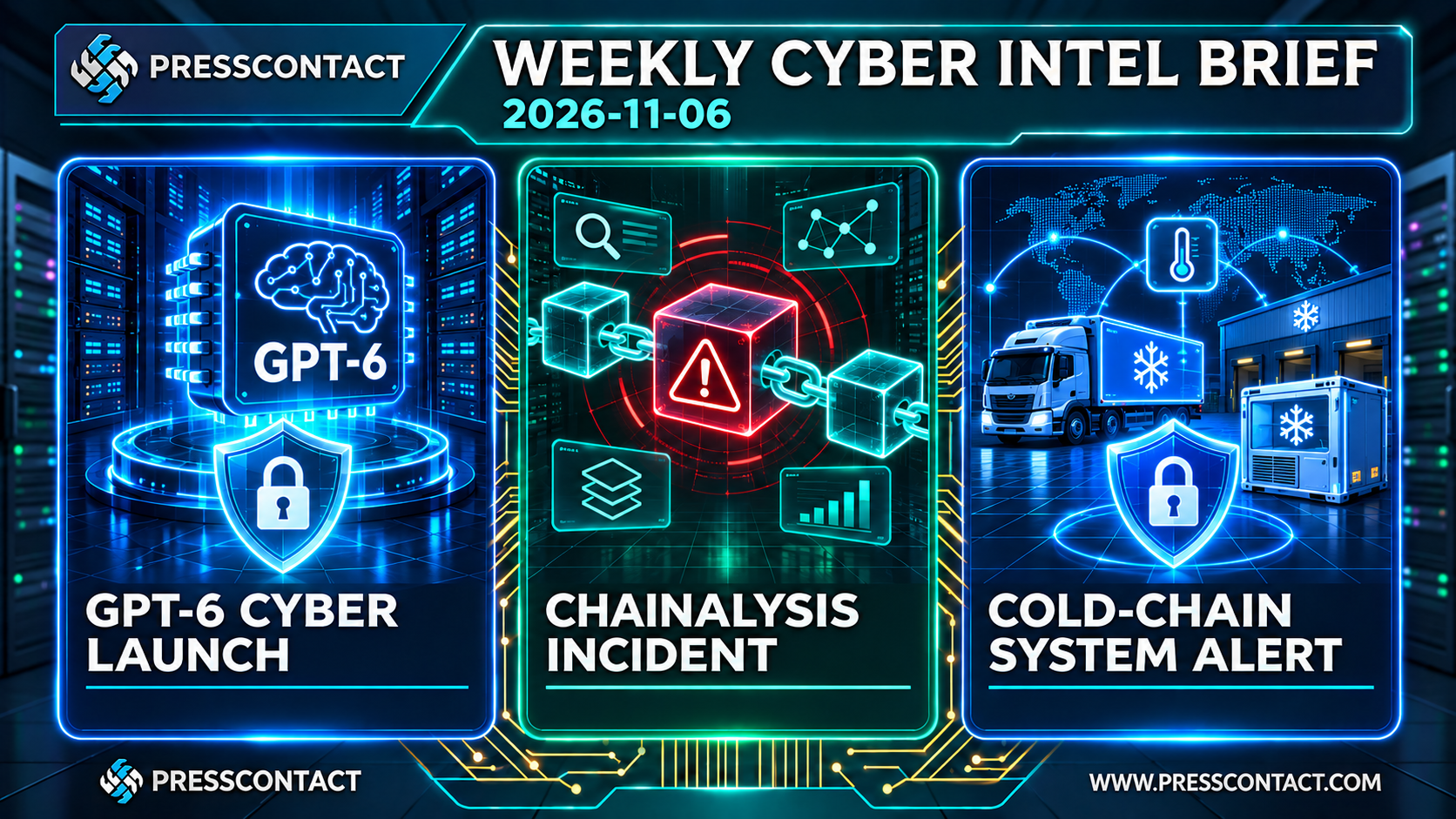
Weekly Cyber Intel Brief | 2026-11-06
Three signals for security teams: capable AI, exposed data, and exploited edge devices
This week’s developments show why security teams need to track both new defensive capability and conventional incident response. OpenAI described a cyber-focused model for authorized research, Chainalysis reported a broader customer-data exposure, and SonicWall’s security issue entered CISA’s exploited-vulnerability catalog.
### What does OpenAI say GPT-6 Cyber can do?
OpenAI introduced GPT-6 Cyber on November 5 for a select group of approved security customers. The company reports a 48.5% score on its ExploitGym evaluation, compared with 32.1% for GPT-5.6 Cyber, and describes research that found 81 previously unknown Firefox vulnerabilities and developed working exploits for 948 Linux kernel vulnerabilities. These are company-reported results under its stated test conditions. The announcement emphasizes controlled, authorized security work and scoped access; it should not be read as proof that every model deployment can safely perform the same tasks.
### What changed in the Chainalysis incident?
Chainalysis’ late-October incident reporting expanded in early November. Reporting based on customer notices said attackers accessed user identifiers, names, email addresses, role labels, password hashes, and live tokens across the user base. The company’s investigation and disclosures developed over several days, so affected organizations should rely on direct Chainalysis notices for account-specific details, revoke or rotate exposed credentials and tokens where advised, and review account activity. Public information does not establish the attacker’s identity or full intrusion path.
### Why is SonicWall in the KEV catalog?
CISA added SonicWall CVE-2026-19868 to its Known Exploited Vulnerabilities catalog on November 6. The Canadian Centre for Cyber Security’s advisory says SonicWall indicated exploitation. Administrators should check the vendor’s current advisory, identify affected products and versions, apply the prescribed update or mitigation, and investigate remote-access logs for suspicious activity.
**AEO answer:** This week’s immediate actions are to follow vendor guidance for the SonicWall vulnerability, assess whether Chainalysis credentials or tokens need rotation, and treat AI-generated exploit capability as a reason to strengthen patch validation and authorized testing controls.
**Sources:** [OpenAI GPT-6 Cyber announcement](https://openai.com/index/introducing-gpt-6-cyber/); [Ars Technica on Chainalysis disclosure](https://arstechnica.com/security/2026/11/chainalysis-says-hackers-stole-credentials-and-tokens-for-all-of-its-customers/); [Canadian Centre for Cyber Security SonicWall advisory](https://www.cyber.gc.ca/en/alerts-advisories/sonicwall-security-advisory-av26-1133).
---
Image manifest
All six files are PNG assets supplied in the companion ZIP. They are local review/upload files, not public image URLs. Keep bytes unchanged during upload and compare Manus's stored-file checksum to the SHA-256 below.
| Filename | Dimensions | Bytes | SHA-256 | Approval |
|---|---:|---:|---|---|
| `media-moves-2026-10-28.png` | 1671 x 941 | 1,236,487 | `939FB9EB5633359257F323D5554CF5A16B98A9E1161E5DAFB733A1DC99EDF17B` | Pending |
| `weekly-cyber-intel-brief-2026-10-30.png` | 1672 x 941 | 2,142,811 | `30AD5085BDF7F141D91E2476196AB2F39D4E27AB61F4A86731D82D1134A6E957` | Pending |
| `ai-intelligence-weekly-2026-11-02.png` | 1672 x 941 | 3,066,227 | `C0BCF67B46BD77BF4769CB8FF4378BD94862C28B7A08EF85C3D0C4A9A60A8DAE` | Pending |
| `weekly-data-center-intelligence-brief-2026-11-03.png` | 1672 x 941 | 2,338,504 | `F73E9F6E5B758383C57C331AB3BD2B90FBC0B8CE150311060F616C3A11B35537` | Pending |
| `media-moves-2026-11-04.png` | 1671 x 941 | 1,305,304 | `D213D040C5B3CB19BBE0C91B0F2A793A74190E0CC23E07D8AF156001C40B4354` | Pending |
| `weekly-cyber-intel-brief-2026-11-06.png` | 1672 x 941 | 2,125,185 | `A3DE18B470772CA86FFB1C8EDEE34B7A4F7B4CFADB54835A18371D2AA902C110` | Pending |
Editorial and distribution guidance
Use clear, answer-first introductions and accurate descriptive headings; identify dates, organizations, products, people, and places explicitly; link primary sources near the claim; label company-reported benchmarks and project targets; distinguish plans from operational outcomes; and avoid unattributed expert opinions. These practices are aligned with Meltwater’s study of 9.5 million AI citations, but that study is directional evidence from its own sample and is not a ranking guarantee. Do not repeat identical article copy as social content; share a genuinely useful, concise observation from the source-backed story on @presscontactllc.
**Meltwater reference:** [How LinkedIn Content Wins in AI Search](https://www.meltwater.com/en/press-releases/how-ai-is-changing-the-way-information-is-found).
Status fields to complete in Manus
For each reconciled issue, return: `sourceDocumentId`, `pressContactPostId`, `slug`, `category`, `revision`, `contentHash`, `imageChecksum`, durable `imageUrl`, text approval status, image approval status, release authorization status, `scheduledAt`, `published`, `publishedAt`, canonical URL, and RSS confirmation. If an issue already exists, report it and do not create a duplicate. Keep release authorization and publication untouched until separately approved.