
Weekly Cyber Intel Brief | 2026-10-19
Weekly Cyber Intel Brief | October 19, 2026
PressContact Blog · 3 minute read
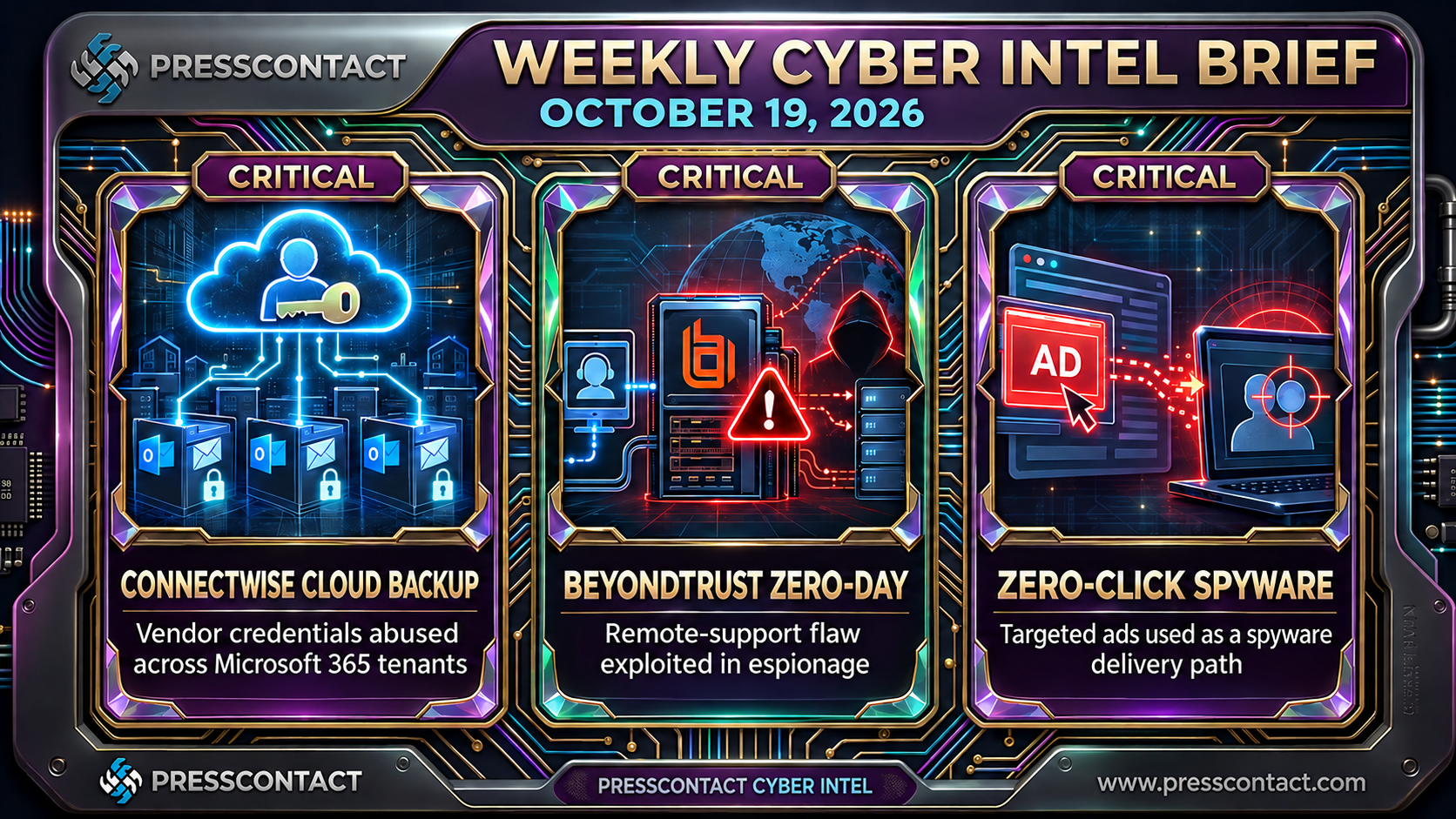
Weekly Cyber Intel Brief ### 2026-10-19
Three developments reported between October 15 and 18 show how attackers are exploiting trusted access rather than simply attacking a public login page. A cloud-backup vendor identity was abused across Microsoft 365 tenants, a remote-support appliance vulnerability was exploited in espionage operations, and researchers documented targeted advertising as a delivery channel for zero-click spyware.
Story 1: ConnectWise Cloud Backup Credentials Abused to Access Microsoft 365 Tenants
**Source published:** October 16, 2026
**Additional advisory updated:** October 18, 2026
[Huntress original investigation](https://www.huntress.com/blog/vendor-credential-enables-unauthorized-access?utm_source=chatgpt.com)
Huntress reported that a compromised application credential associated with ConnectWise Cloud Backup, formerly SkyKick, was used to authenticate to customer Microsoft 365 environments.
Its investigation confirmed unauthorized sign-ins in **162 tenants as of October 16**.
ConnectWise separately acknowledged unauthorized access to application identities, suspended its former SkyKick Cloud Backup service, and said investigation and remediation were continuing as of October 18. The number observed by Huntress is a time-specific finding, not a final incident total.
**Why it matters:** A vendor application can hold extensive permissions across mailboxes, files and directory data. An identity breach at a service provider can therefore cross customer boundaries without an attacker first stealing each customer's employee credentials. Organizations should review the vendor's incident guidance and their own application permissions and sign-in evidence.
Story 2: China-Linked Actor Exploited BeyondTrust Remote Support Zero-Day
**Source published:** October 15, 2026
[Google Threat Intelligence Group and Mandiant investigation](https://cloud.google.com/blog/topics/threat-intelligence/armory-castle-exploits-beyondtrust/?utm_source=chatgpt.com)
Google Threat Intelligence Group and Mandiant disclosed evidence that the suspected China-linked actor ARMORY CASTLE exploited CVE-2026-102764 in BeyondTrust Remote Support as a zero-day in late August.
Investigators described post-exploitation persistence, privilege escalation and use of the SAWFLY webshell and BARECLAW tunneler.
BeyondTrust published its BT26-05 advisory on October 15 and said patches had been released on October 8, with SaaS instances patched automatically and self-hosted customers needing to ensure the fix was applied.
**Why it matters:** Remote-support infrastructure is a privileged bridge into other systems. A compromised support appliance can become a durable access point, especially when attackers remove logs or hide behind legitimate administration functions. The distinction between an available patch and evidence of an already-compromised appliance is operationally important.
Story 3: Citizen Lab Documents Zero-Click Spyware Delivered Through Targeted Ads
**Source published:** October 15, 2026
[Citizen Lab technical investigation](https://citizenlab.ca/research/how-discover-tech-turned-targeted-ads-into-a-pipeline-for-spyware/?trk=public_post_comment-text&utm_source=chatgpt.com)
Citizen Lab published technical findings on *AdFection*, a technique it says allowed targeted online advertisements to deliver Candiru mercenary spyware without a victim clicking the ad.
Its investigation linked Discover-Tech's Controlium platform to advertising-based targeting and documented spyware infections at Al Jazeera.
The researchers also examined billions of ad-bidding records, illustrating how advertising infrastructure can be used to identify and reach devices. Exposure to an advertisement or inclusion in bidding records should not be confused with confirmed spyware infection.
**Why it matters:** The research expands the threat model for high-risk users such as journalists, activists and government personnel. Advertising infrastructure can be used for surveillance and, in documented cases, infection without the familiar phishing step. The findings also raise questions about ad-network vetting and device protection for sensitive work.
### Conclusion
The week's three investigations concern different attack surfaces, but each centers on a trusted intermediary: a cloud-backup application, a remote-support product, or an advertising delivery system. For defenders, the immediate priorities differ by incident, so the primary advisories and research should guide any remediation decisions.