
Weekly Cyber Intel Brief | 2026-10-16
This week’s infrastructure updates span Windows, web delivery and virtualization. The common requirement is to connect a published fix with the exact systems and configurations in use.
PressContact Blog · 2 minute read
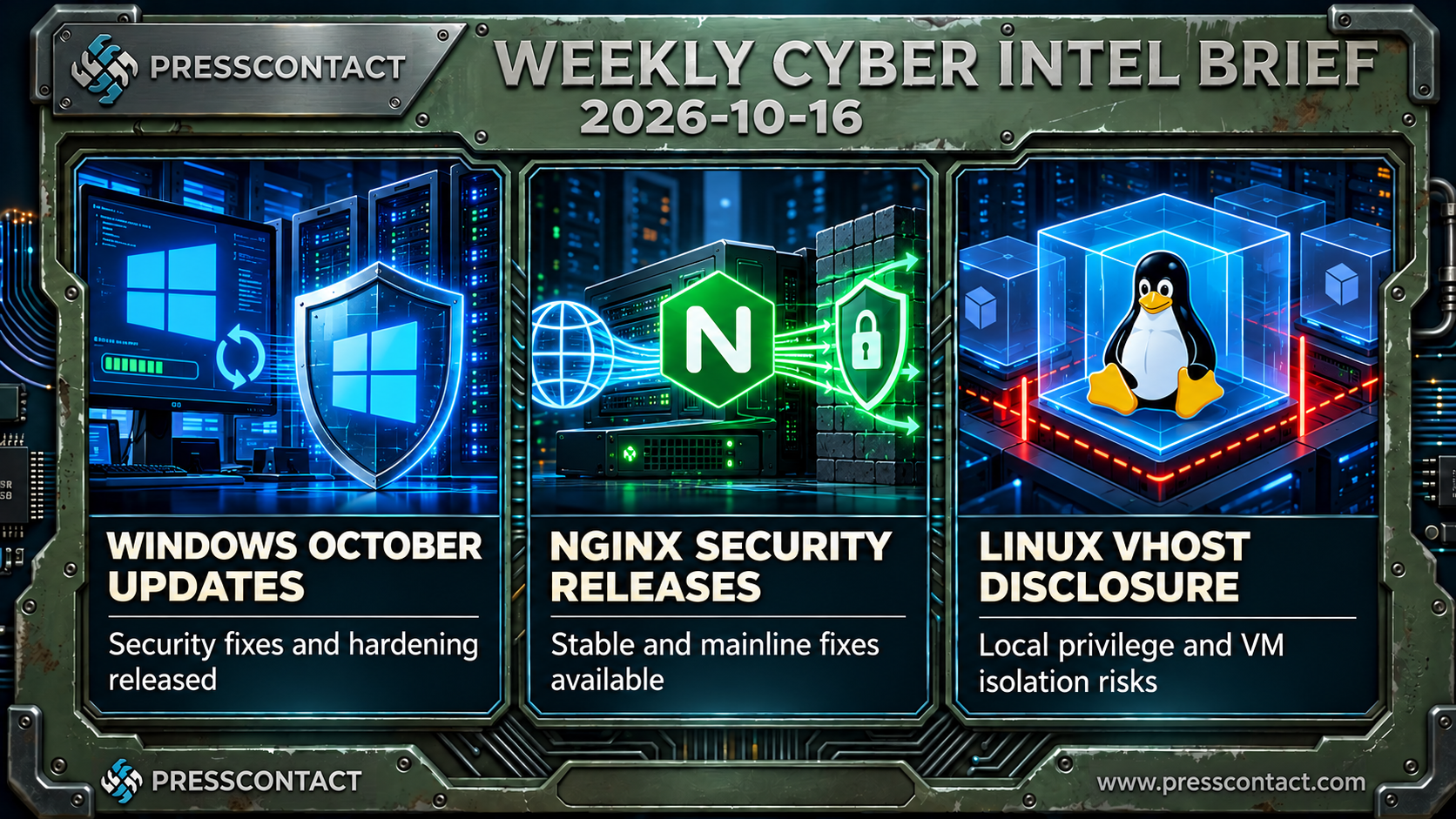
Weekly Cyber Intel Brief | 2026-10-16
This week’s infrastructure updates span Windows, web delivery and virtualization. The common requirement is to connect a published fix with the exact systems and configurations in use.
1. Microsoft issues October Windows security updates and hardening changes
Microsoft’s October 13 Windows message-center entries announce the monthly security update and several hardening changes. These include the start of an audit phase for removable ReFS configurations and enforcement of AD FS Distributed Key Manager permissions protections. Microsoft also explains administrator-protection behavior in its Windows security baselines. The entries describe different features and deployment conditions, rather than one universal change for every Windows installation.
**Why it matters:** Operations and communications teams need a shared change inventory. Compatibility checks and user-facing notices should reflect the particular controls being enabled.
[Source: Microsoft](https://learn.microsoft.com/en-us/windows/release-health/windows-message-center)
2. NGINX ships paired security releases
The NGINX project announced stable version 1.30.6 and mainline version 1.31.7 on October 14. Its release notice identifies five security issues involving configurations or functionality such as alias and rewrite processing, HTTP/3, TLS session-ticket rotation, and server-side includes with asynchronous I/O. Operators should use the project’s advisories to determine which conditions apply to their own deployments.
**Why it matters:** The version number is only part of an exposure assessment. Enabled modules, configuration and the distribution’s backported fixes also affect the response.
[Source: NGINX](https://nginx.org/)
3. Researchers disclose Linux vhost isolation risks
An October 14 oss-security disclosure from Tencent researchers describes Vghost, CVE-2026-74580, involving stale metadata in Linux vhost handling. The disclosure presents local privilege-escalation and guest-to-host attack paths under specified conditions. It links the upstream fix and notes that vendor kernels can contain backports while retaining an older base version. A local or guest prerequisite should not be described as an unrestricted internet-facing exploit.
**Why it matters:** Virtualization assurance needs evidence about device access and guest configuration, alongside patch status. Those prerequisites belong in any external explanation of risk.
[Source: Tencent research disclosure via oss-security](https://www.openwall.com/lists/oss-security/2026/10/14/2)
The PressContact view
Patch reporting works best when it explains scope and completion. A release announcement is the beginning of remediation, while deployment records, configuration checks and validation establish what the organization can accurately say afterward.