
Weekly Cyber Intel Brief | 2026-10-09
Remote-access appliances, developer dependencies and everyday browsers share this week’s patching agenda. Three disclosures show why exposure needs to be tracked across the whole software estate.
PressContact Blog · 2 minute read
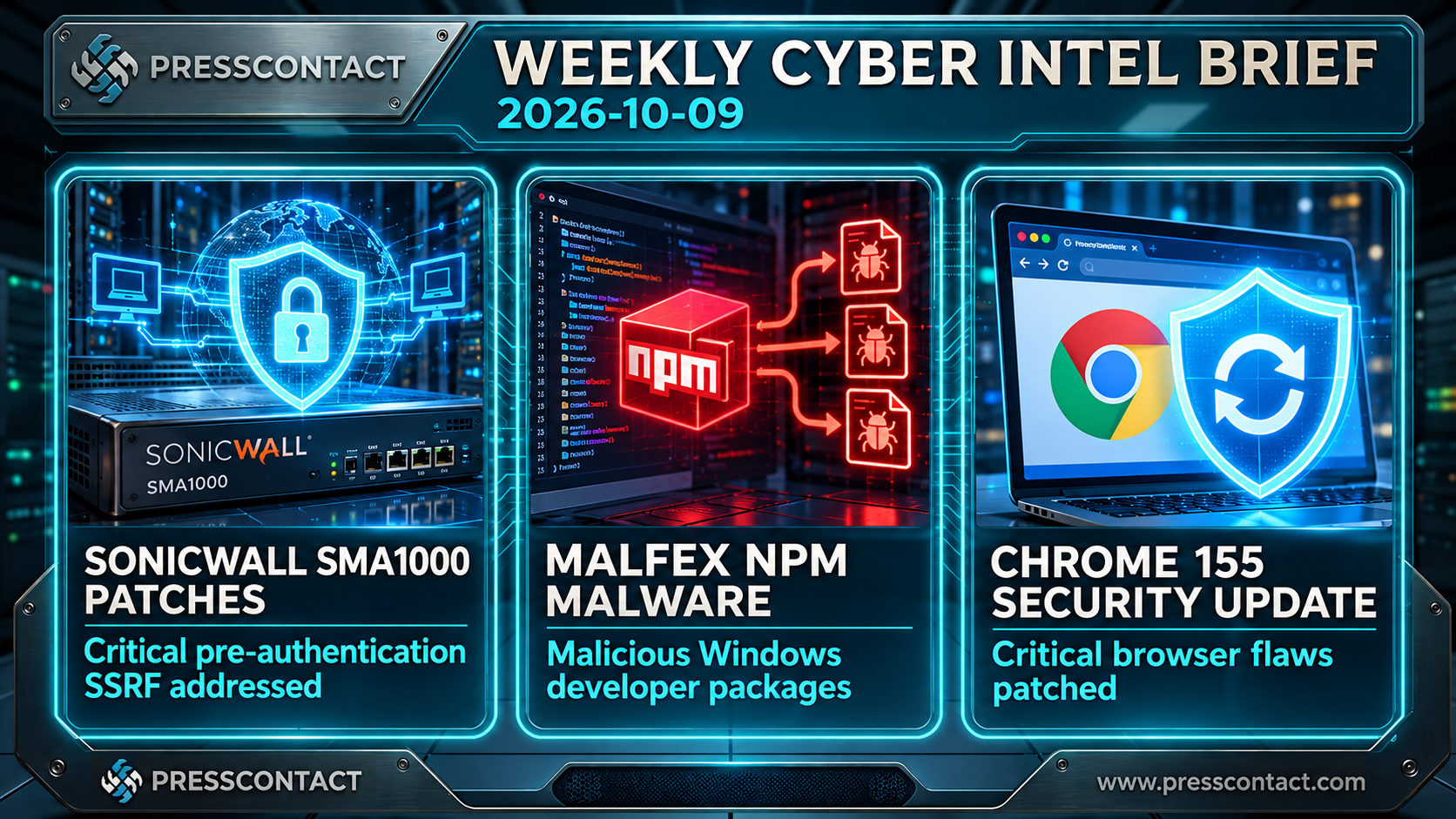
Weekly Cyber Intel Brief | 2026-10-09
Remote-access appliances, developer dependencies and everyday browsers share this week’s patching agenda. Three disclosures show why exposure needs to be tracked across the whole software estate.
1. SonicWall addresses four SMA1000 vulnerabilities
SonicWall’s October 6 advisory describes four flaws affecting SMA1000 appliances, including a pre-authentication server-side request forgery issue rated CVSS 10.0. The advisory identifies affected 6210, 7210 and 8200v models and provides fixed platform-hotfix versions. It explicitly distinguishes these products from firewall SSL-VPN and the SMA 100 series. The disclosure establishes a patching requirement; it does not, by itself, establish that a particular customer has been compromised.
**Why it matters:** Product identification matters. An appliance inventory should be matched to the vendor’s affected-version table before teams describe their exposure or remediation status.
[Source: SonicWall](https://psirt.global.sonicwall.com/vuln-detail/SNWLID-2026-0017)
2. Checkmarx traces the MALFEX npm malware campaign
Checkmarx published research on October 5 connecting a long-running npm malware campaign to packages that deliver Windows malware through several execution paths. Its analysis describes a remote-access trojan loader, an information stealer and a downloader. The researchers reported 40,767 downloads across the malicious packages using registry statistics from October 1. Downloads describe distribution, not a confirmed count of infected systems.
**Why it matters:** Dependency review belongs beside endpoint monitoring. A package’s age or download history does not establish that the version being installed is trustworthy.
[Source: Checkmarx](https://checkmarx.com/zero-post/malfex-npm-malware-campaign-three-payloads-and-an-adversary-that-signs-their-work/)
3. Google releases Chrome 155 with critical security fixes
Google’s October 6 desktop stable-channel release lists 247 security fixes and critical use-after-free issues, including CVE-2026-106358 in Navigation. The announcement identifies the updated Windows, Mac and Linux builds and notes that rollout takes place over time. A browser being open does not demonstrate that a newly downloaded update has been applied.
**Why it matters:** Browser patch communications should include a way to confirm the running version. Enterprise rollout and user completion are separate steps.
[Source: Google Chrome Releases](https://chromereleases.googleblog.com/2026/10/stable-channel-update-for-desktop_086471744.html)
The PressContact view
These are three different exposure paths: remote access, software supply chains and browsing. A useful response separates what is affected, what has been updated and what has actually been observed. Communications should preserve those distinctions rather than turn every advisory into a breach claim.