
Invited to Test MemMachine | Why This AI Memory Layer Matters for PR and Communications Pros
MemMachine is an open-source memory layer for AI agents. For PR teams, persistent context could help carry approved brand and campaign information between tasks, while personas and model comparison features require transparency, verification and human review.
PressContact Blog · 8 minute read
Invited to Test MemMachine | Why This AI Memory Layer Matters for PR and Communications Pros
There are practical ways to reduce context loss, including thoughtful folder structures and backups in tools such as Notion or Obsidian. Those approaches still matter. But the issue I'm focused on is one I'm dealing with now: helping AI tools carry useful, approved context from one task to the next without making staff rebuild the background each time. I was recently invited to early-test MemMachine, an open-source memory layer for AI agents. I was happy to take a look, and I'm glad I did.
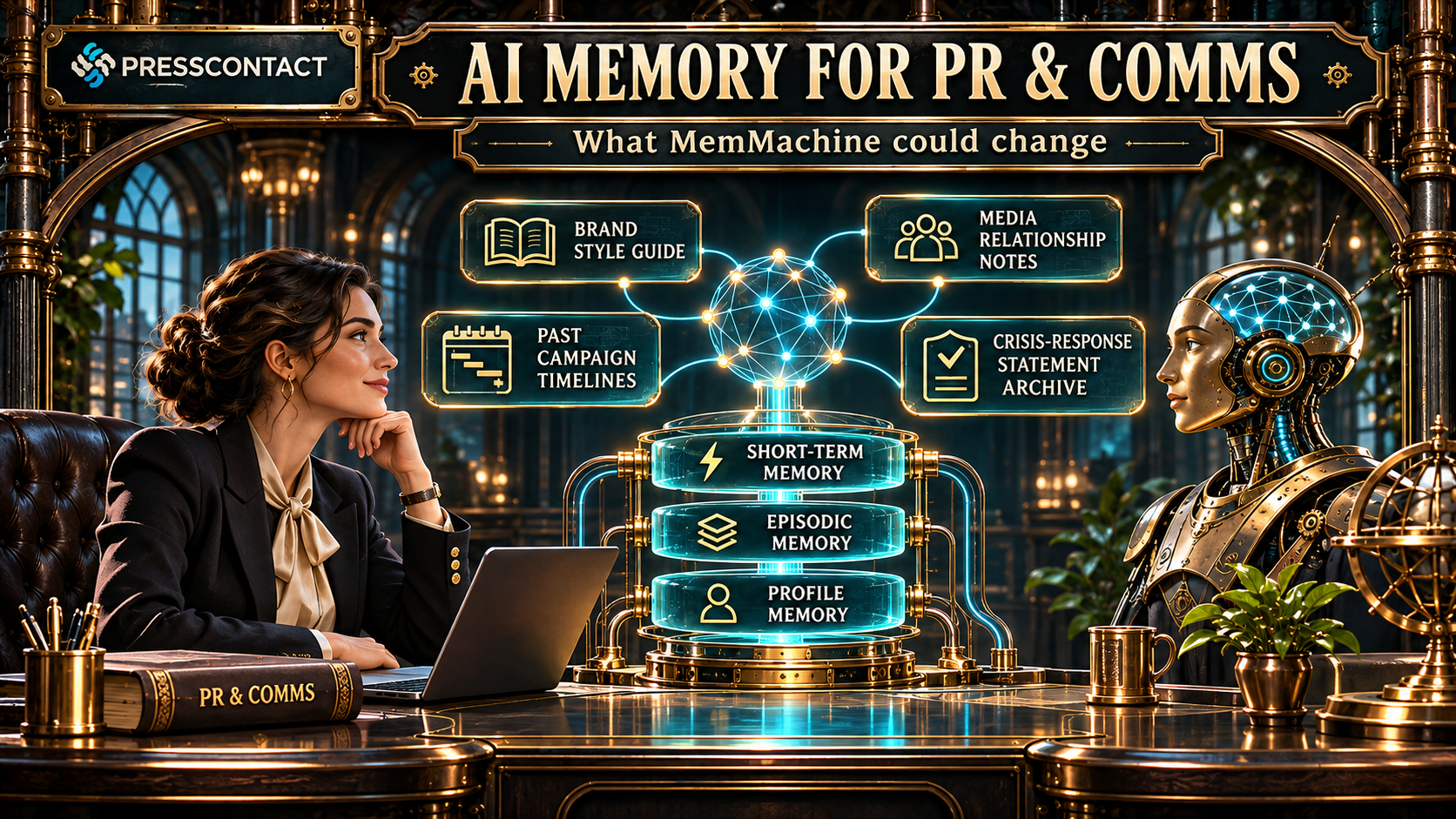
MemMachine is designed to let AI applications store and retrieve information from earlier interactions. Its project materials describe working memory for current-session context, episodic memory for conversational history, and profile memory for longer-term facts and preferences. The project's website also summarizes these ideas as short-term, long-term and personalization memory. The exact terminology varies across its materials, so teams should evaluate the implementation and controls rather than rely on labels alone. [MemMachine GitHub](https://github.com/MemMachine/MemMachine) · [MemMachine website](https://memmachine.ai/)
The short answer
An AI memory layer gives an agent a way to retrieve selected context from earlier sessions. For PR and communications teams, that could mean bringing an approved brand voice guide, campaign history or prior response into a new task. It does not make every memory accurate, current or appropriate to use. People still need to set access rules, review retrieved information and approve external communications.
Why memory matters in communications
Many communications workflows stretch across weeks or years. The details that shape a good decision may be scattered across campaign briefs, approved statements, coverage reports, media notes and team handoffs. A new session or a different tool can lose that context.
A connected memory layer could help an AI agent retrieve relevant material when asked. For example, a writing assistant might look up the current terminology guide and approved boilerplate before drafting. A monitoring workflow might share selected campaign context with a reporting assistant. These connections depend on how an organization configures its agents, data sources and permissions; they are not automatic simply because a memory product is installed.
### Personas: useful for people, companies and brands
The MemoryBox screenshots you shared show a persona feature that builds a profile from conversations. A user can create, edit and switch personas, and the profile view groups traits such as communication style, decision preferences, behavior patterns, psychographics, and values or attitudes. This is a separate MemoryBox interface feature, not a capability I am attributing to MemMachine's memory architecture.
For a communications professional, a carefully managed persona could preserve practical working preferences: concise drafts, examples before recommendations, approved terminology, or a preference to review visual options iteratively. That can make an assistant's next response more useful without requiring the same instructions in every session.
The risk is that a system may infer a trait incorrectly from limited conversations. A confidence percentage is not proof that a characterization is true. In PR, that distinction matters: a wrong assumption about a spokesperson, client, journalist or audience can distort tone, lead to stereotyping, or cause a team to over-personalize outreach. Keep personas transparent and editable. Separate explicit user-stated preferences from machine-inferred traits, show what the system relied on, and let people correct, disable or delete the profile. Avoid inferring sensitive traits or building hidden profiles of journalists and other third parties.
A separate MemoryBox function in the screenshots you shared also caught my attention: ask one question and compare answers from up to three AI models. The settings screen you shared also shows model-selection controls. For a communications team, the comparison could support a structured review: provide the same approved brief to each model, then compare factual omissions, tone, audience fit and unsupported claims. These are MemoryBox interface functions shown in your screenshots, distinct from MemMachine's memory architecture. Model agreement is not verification, so source checking and human approval remain necessary.
MemMachine's public materials describe it as model-agnostic and available for self-hosted or managed use. Its GitHub project lists APIs and integrations for multiple agent frameworks. These are product capabilities, not a guarantee that a particular PR system will fit without engineering, security review or configuration. [Project documentation](https://github.com/MemMachine/MemMachine) · [MemMachine documentation](https://docs.memmachine.ai/)
Sample use case: a fast-moving customer incident
**Illustrative scenario only - not a real PressContact client or a report of a completed MemMachine deployment.**
A cybersecurity company is responding to a service incident. Its communications team has already approved a holding statement, a short fact sheet, spokesperson availability and a list of claims that must not be made until the investigation is complete.
A memory-enabled workflow could work like this. At the outset, a communications profile might record explicit workflow preferences, such as a request for concise, source-linked drafts. It should not create hidden personality profiles of journalists or other third parties.
1. **Monitoring assistant:** Collects new coverage and flags questions that relate to the incident. It stores links, timestamps and source excerpts in the incident record.
2. **Context retrieval:** When asked to prepare a response, the drafting assistant retrieves the approved holding statement, current confirmed facts, brand terminology and relevant prior updates.
3. **Drafting assistant:** Produces a proposed response and identifies which statements came from the approved fact sheet, while marking unanswered questions instead of filling gaps.
4. **Human review:** The communications lead checks that facts are still current, confirms source links, consults legal or security colleagues as needed, and approves or rewrites the response before anything is sent.
5. **Learning with controls:** After the incident, the team decides which final statements and lessons should remain available, who can access them, and when older details should be corrected or deleted.
The benefit is continuity: staff and tools can start from the same selected history. The control point is equally important: retrieved memory should be treated as a lead to verify, not as an authoritative source by itself.
What PR teams should test
An early evaluation should focus on practical reliability and governance, not only whether a demo feels personalized:
- **Retrieval quality:** Does it bring back the right approved fact, with enough context to interpret it?
- **Source and date visibility:** Can a reviewer see where a memory came from and when it was last confirmed?
- **Correction and deletion:** Can staff update a stale preference or remove information that should no longer be retained?
- **Access boundaries:** Can separate clients, teams and incident workspaces be kept apart?
- **Human approval:** Can the system clearly distinguish a draft suggestion from an approved statement or sent message?
- **Portability and hosting:** What data is stored, where is it stored, which models and tools can access it, and what does self-hosting require?
- **Failure behavior:** What happens when retrieval returns nothing, returns conflicting memories, or is unavailable?
For sensitive client or journalist information, teams should establish a lawful basis, clear retention limits, role-based access and a review process before placing it in a persistent memory system. Avoid storing confidential or personal details unless they are necessary, authorized and protected under the organization's policies.
Why this is worth watching
A durable memory layer could help turn isolated AI tasks into a more continuous workflow. In communications, that may reduce repeated briefing and make approved context easier to retrieve across specialized tools. The value will depend on implementation quality: whether teams can inspect, correct, scope and delete memories, and whether the system reliably distinguishes remembered context from verified facts.
My early-test invitation is an opportunity to explore those questions. It is not, by itself, evidence that the system has improved campaign outcomes or that every capability is production-ready. The useful test is a bounded workflow with non-sensitive material, clear success criteria and a human reviewer at every external communication step.
Optional hands-on exploration
The author supplied this MemBox link for readers who want to explore a related MemMachine demo: [Try MemBox](https://membox.memmachine.ai/?ref=76R9FXC767). The URL contains a referral parameter. Check the service's current terms and data handling before entering any information.
Frequently asked questions
### What is MemMachine?
MemMachine is an open-source memory layer for AI agents and applications. Its public project describes working, episodic and profile memory, with APIs and integrations intended to help applications store and retrieve context across interactions. [Source](https://github.com/MemMachine/MemMachine)
### How could AI memory help a PR team?
It could help an AI workflow retrieve selected brand guidance, campaign history or approved response material for a later task. The team must configure permissions and verify retrieved facts before use.
### Does MemMachine automatically share information between every AI agent?
No. Agents need to be integrated and configured to access the relevant memory scope. Access should be limited to the people, systems and projects that are authorized to use that context.
### Does persistent AI memory mean the system remembers everything correctly?
No. A memory layer stores and retrieves information, but it can return incomplete, outdated or irrelevant details. Teams should check provenance and dates, resolve conflicts and keep human approval for consequential communications.
### Can an organization self-host MemMachine?
MemMachine's public materials say the open-source version can be deployed in a private cloud or on-premises environment. Self-hosting still requires the organization to operate, secure and maintain the infrastructure. [Source](https://memmachine.ai/)
Sources
- [MemMachine project on GitHub](https://github.com/MemMachine/MemMachine)
- [MemMachine official website](https://memmachine.ai/)
- [MemMachine documentation](https://docs.memmachine.ai/)