
Weekly Data Center Intelligence Brief | 2026-10-27
NVIDIA efficiency claims, Polar’s factory-built Norway deployment and Meta’s Prometheus operating details show three ways AI infrastructure becomes productive capacity.
PressContact Blog · 3 minute read
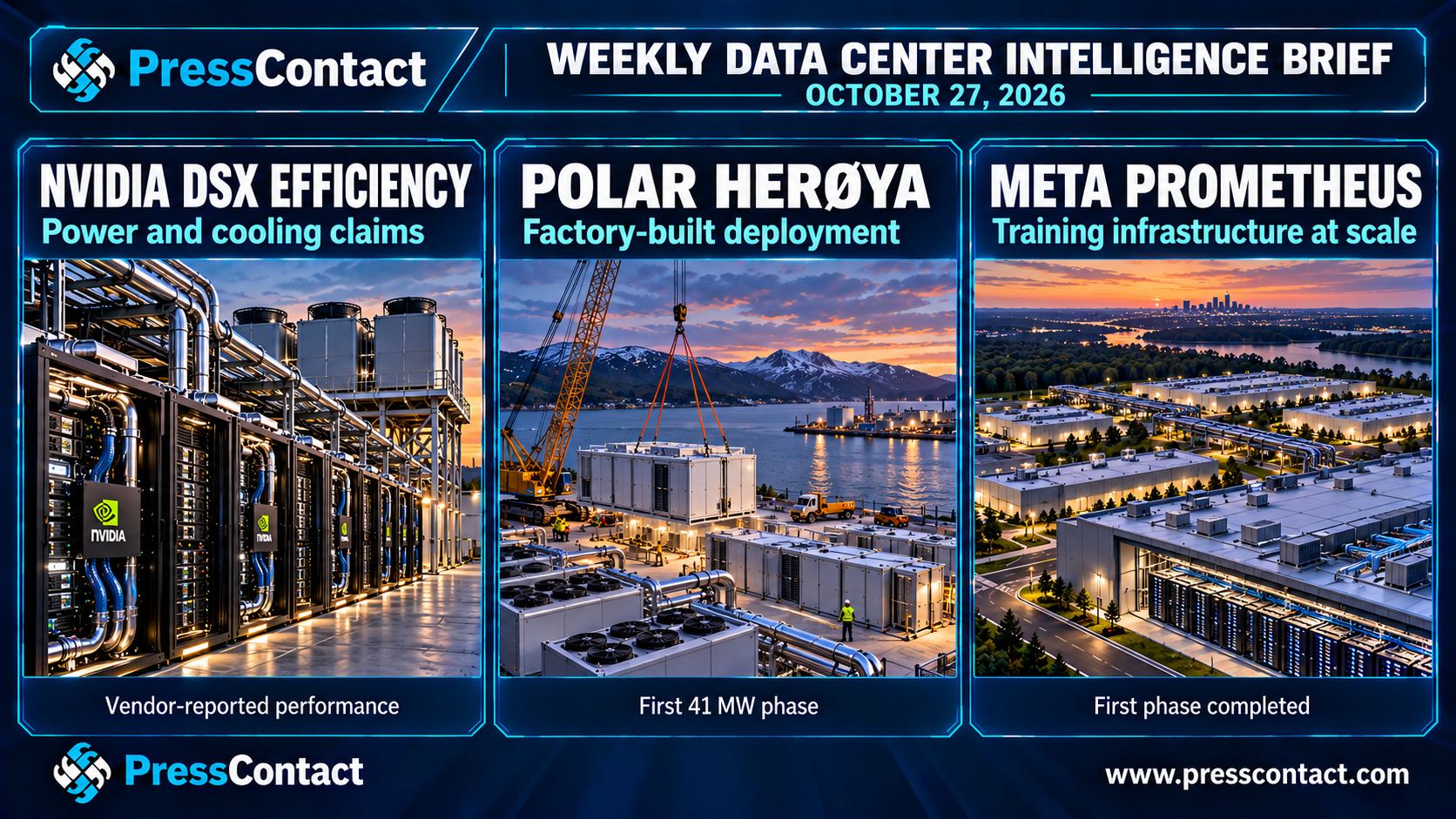
Weekly Data Center Intelligence Brief | 2026-10-27
The next stage of AI infrastructure is being judged by what a facility can deliver from its available power, how quickly it becomes usable, and how reliably its systems run together. Three recent primary-source announcements approach that question from different directions: NVIDIA's efficiency architecture, Vertiv's deployment model and Meta's operating experience.
1. NVIDIA ties AI factory efficiency to power allocation and cooling design
In its October 21 announcement, NVIDIA describes European adoption of its DSX AI Factory Platform. The company says DSX MaxLPS can deliver the same token output with up to 30% less power through dynamic power allocation. That is a vendor-reported capability, not a measured result for every customer or workload.
The announcement also describes closed-loop liquid cooling connected to outdoor dry coolers. NVIDIA says suitable designs can bring facility cooling water use close to zero, while noting that local climate can require supplemental mechanical cooling during hot periods. Facility cooling water is a narrower measure than a data center's entire water footprint.
**Why it matters:** Operators need to compare useful computing output with the power and cooling resources actually available at a site. Efficiency descriptions should identify the workload, system boundary and conditions behind the result.
**Communications implication:** Keep energy and water claims specific. State whose result is being reported, what was measured and which site conditions could change it.
[Source: NVIDIA announcement, October 21, 2026](https://investor.nvidia.com/news/press-release-details/2026/European-Ecosystem-Builds-Worlds-Most-Efficient-AI-Factories-With-NVIDIA-DSX/default.aspx)
2. Polar applies Vertiv's factory-built approach at Herøya
Vertiv's October 21 release says Polar Data Centers is applying a factory-built deployment model to the first 41 MW phase of its Herøya campus in Norway. The approach brings more power and thermal infrastructure assembly, integration and testing into the factory before equipment reaches the site.
Vertiv also presents a modeled comparison in which configuration and deployment together fall from approximately 120 days to 48 days. Its associated claim of up to 30% more cumulative token output in the first year reflects earlier availability at the same installed capacity. It should not be interpreted as a 30% increase in the instantaneous performance of an unchanged processor. The release says actual results vary.
**Why it matters:** Time to productive capacity includes more than delivery of computing equipment. Design coordination and site integration can influence when a facility starts serving workloads.
**Communications implication:** Separate the named deployment from the modeled timetable. Identify which milestones have been achieved before describing an entire campus as operational.
[Source: Vertiv announcement, October 21, 2026](https://www.vertiv.com/en-anz/about/news-and-events/news-releases/2026/vertiv-targets-up-to-30-more-cumulative-ai-token-output-in-first-12-months-using-nvidia-dsx-polar-deploys-approach-at-norway-site/)
3. Meta explains the systems behind Prometheus
In an October 19 engineering account, Meta says the first phase of its Prometheus supercluster in New Albany, Ohio, is complete and was used to train its Muse foundational models. The company describes hundreds of thousands of GPUs across interconnected buildings and a plan to reach roughly one million GPUs at full scale. The larger figure is a future scale target, not the completed first-phase count.
Meta reports more than 85% goodput for pre-training and more than 90% for reinforcement-learning runs of Muse Wonder. These are Meta's reported operating results for those runs. The engineering account connects useful training time to coordinated networking, hardware and reliability work, alongside closed-loop liquid cooling.
**Why it matters:** Installed accelerator count is only one measure of an AI facility. Sustained productive operation also depends on how the cluster handles interruptions and communication between systems.
**Communications implication:** Pair capacity figures with a clear operating milestone. Explain whether a number describes equipment installed today, a completed training run or the final expansion plan.
[Source: Engineering at Meta, October 19, 2026](https://engineering.fb.com/2026/10/19/data-center-engineering/inside-prometheus-meta-gigawatt-scale-supercluster/)
What connects these developments
Power efficiency, earlier commissioning and sustained useful work describe different parts of the same operating story. A useful infrastructure announcement explains its starting point and the boundary of its claim. For communications teams, the strongest account connects an engineering change to an observable milestone without turning a design target into a delivered result.