
Weekly Data Center Intelligence Brief | 2026-10-21
NVIDIA’s modular DSX POD, Microsoft’s withdrawal from Nscale’s Loughton project and a Goldman Sachs power-demand forecast show why site readiness, grid access and electricity supply shape data center timelines.
PressContact Blog · 3 minute read
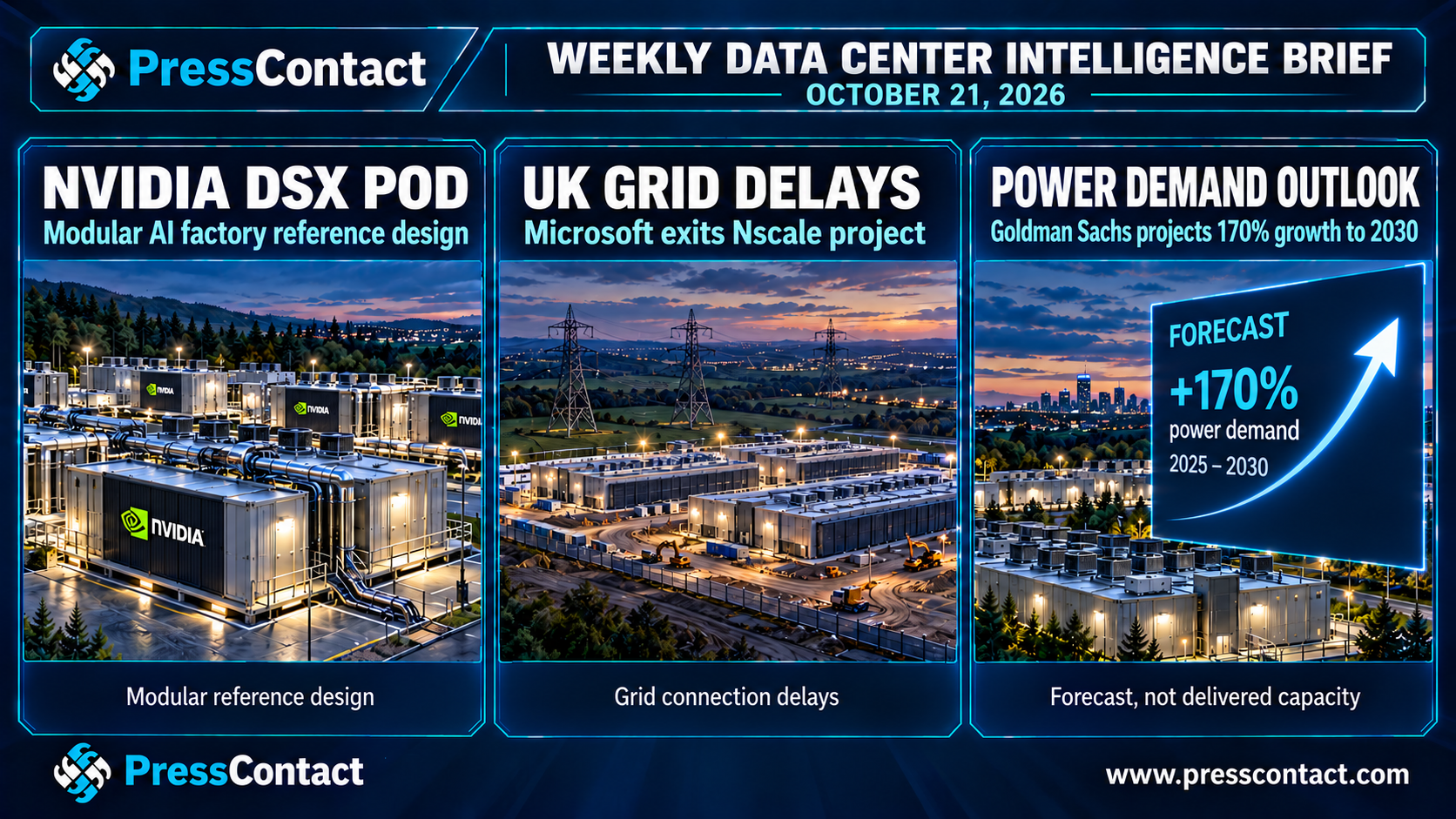
Weekly Data Center Intelligence Brief | 2026-10-21
This week’s three infrastructure developments concern modular AI computing, grid-connection delays and the projected electricity requirements of data center expansion.
1. NVIDIA introduces modular DSX POD AI factories
NVIDIA introduced DSX POD, a modular reference design for Vera Rubin AI factories assembled and validated before shipment. The company says a prepared site could move from an approximately six-month infrastructure deployment to as little as 14 days. NVIDIA expects partners to begin delivering the systems in early 2027.
What the 14-day claim means: NVIDIA describes deployment at a prepared site. It is not a guarantee for a new greenfield project. Power, cooling and networking must already be available.
Source: NVIDIA Newsroom
2. Microsoft exits Nscale’s UK data center project after power delays
Microsoft withdrew from an agreement to anchor Nscale’s proposed AI data center in Loughton, Essex, after grid connection delays pushed expected electricity availability into the 2030s. The plan called for a 50-megawatt site with 23,040 NVIDIA GPUs. Microsoft said its broader partnership with Nscale continues.
Why it matters: Grid access can determine whether a planned data center reaches operation, regardless of GPU procurement or commercial commitments. The withdrawal concerns the Loughton project; it does not mean Microsoft ended its broader partnership with Nscale.
Source: Reuters report, syndicated by Investing.com
3. Goldman Sachs projects 170% growth in data center electricity demand
Goldman Sachs Research projects global data center power demand to increase by 170% from 2025 to 2030, with more than 60% of that growth occurring in the United States. Its analysis identifies interconnection, permitting, equipment, labor, financing and community concerns as constraints on development.
Forecast, not measured growth: The 170% figure is a projection. It indicates the scale of energy and infrastructure capacity that new projects may need to secure; it is not observed demand growth to date.
Source: Goldman Sachs, “Navigating a System of AI Bottlenecks”
The PressContact view
Together, the announcements point to three different parts of the delivery problem: factory integration may shorten equipment deployment at prepared sites; grid availability can delay a specific project even when computing hardware and a customer are lined up; and rising power demand is a forecast that increases the importance of generation, transmission, permitting and community planning. Keep vendor claims, project plans and research forecasts clearly attributed and distinguish them from operating capacity or measured outcomes.
Frequently asked questions
What is NVIDIA DSX POD?
DSX POD is NVIDIA’s modular reference design for Vera Rubin AI factories. Partners integrate and validate systems inside modular containers before delivery. NVIDIA says deployment at a prepared site could take as little as 14 days; the claim assumes the site already has supporting power, cooling and networking.
Why did Microsoft leave the Nscale Loughton project?
Reuters reported that Microsoft withdrew as anchor customer after delays to the project’s expected grid connection pushed electricity availability into the 2030s. Microsoft said its broader partnership with Nscale continues.
Is data center electricity demand already 170% higher?
No. Goldman Sachs Research projects a 170% increase in global data center power demand between 2025 and 2030. That is a forecast, not a measurement of growth that has already occurred.
What most affects a data center project’s timeline?
The three developments here illustrate site readiness, grid connection and power supply as schedule factors. A modular design may reduce deployment time at a prepared site, but it cannot by itself remove delays in electricity access, permitting or supporting infrastructure.