
Data Center Intelligence Brief | 2026-10-19
Data Center Intelligence Brief | October 19, 2026
PressContact Blog · 3 minute read
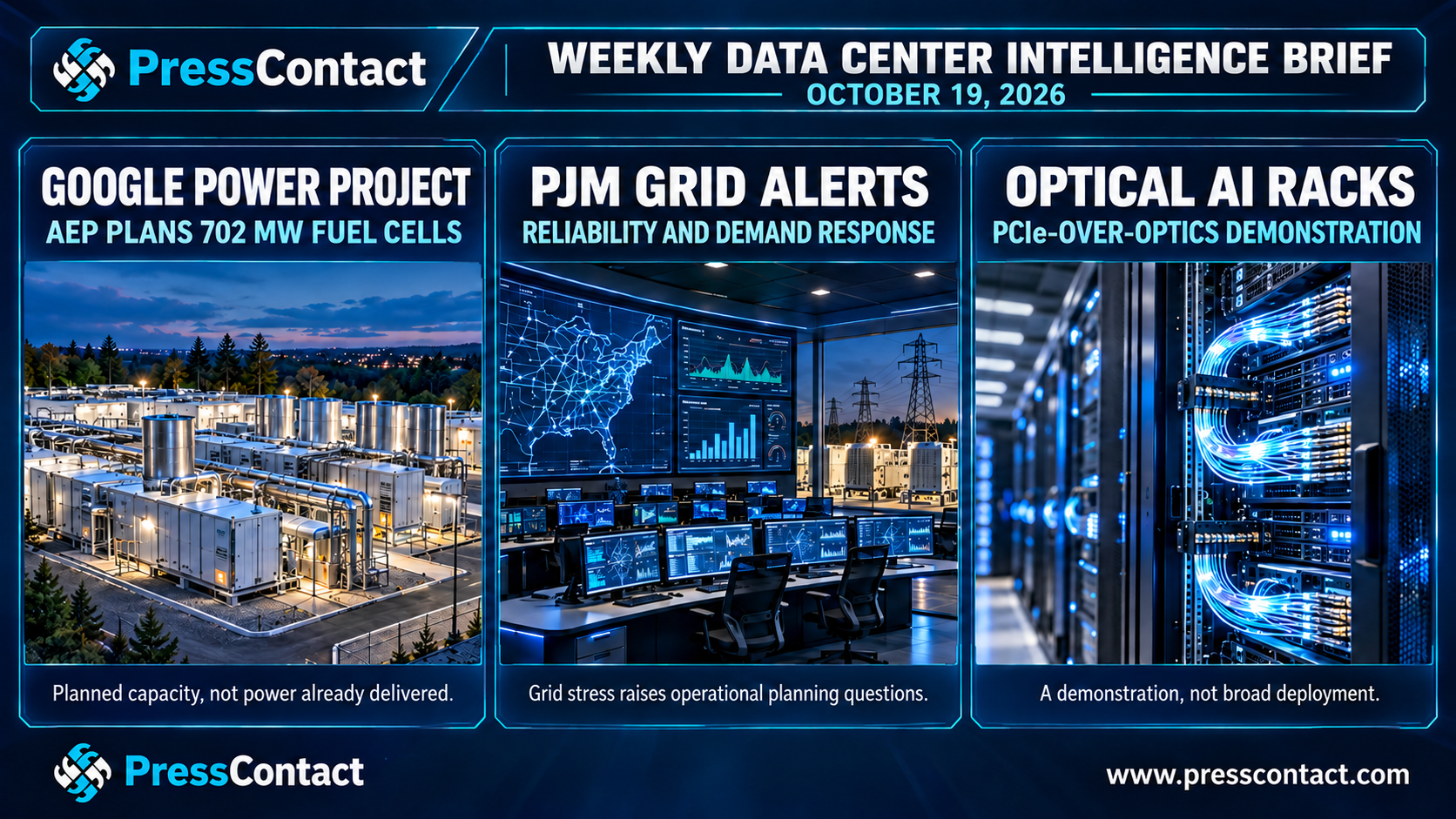
Data Center Intelligence Brief ### 2026-10-19
Data center growth increasingly depends on infrastructure outside the server hall. This week, a large fuel-cell project offered one answer to time-to-power constraints, a mid-Atlantic grid operator activated reliability procedures during unusually tight conditions, and three technology suppliers demonstrated an optical alternative to some short-reach electrical connections inside AI racks.
Together, the developments put power availability and interconnect design at the center of the build-out.
Story 1: AEP Plans 702 MW Fuel-Cell Project to Supply Google in Wyoming
**Source published:** October 14, 2026
[American Electric Power announcement](https://www.aep.com/news/stories/view/12314/?utm_source=chatgpt.com)
American Electric Power announced plans to invest approximately $4 billion in a 702-megawatt fuel-cell generation project near Cheyenne, Wyoming, under a 20-year power purchase agreement with Google.
The company expects construction to begin in 2026 and the facility to be fully operational by the end of 2028.
AEP said the project will use Bloom Energy fuel-cell technology and includes plans for carbon capture.
These are forward-looking project plans, not power capacity already delivered to Google.
**Why it matters:** AI data center schedules increasingly depend on firm power that can be commissioned on a predictable timetable. A large modular fuel-cell deployment may offer an alternative to waiting for traditional generation and transmission upgrades, but capital cost, fuel supply, emissions and execution risk remain essential considerations.
Story 2: PJM Extends Generation and Load-Management Alerts Amid Grid Stress
**Source published:** October 13, 2026
**Updated:** October 14, 2026
[PJM Interconnection operations update](https://insidelines.pjm.com/operations-update-extends-maximum-generation-alert-calls-on-demand-response/?utm_source=chatgpt.com)
PJM Interconnection extended a Maximum Generation Alert and Load Management Alert through October 14 as unusually warm fall weather coincided with scheduled equipment outages.
PJM also described a federal emergency order permitting specified additional generation and, under defined circumstances, use of backup generation at data centers and other large loads.
The alert was a grid reliability action, not a statement that data centers alone caused the conditions or that widespread blackouts occurred.
**Why it matters:** For data center operators, grid constraints are an immediate operational planning issue, not only a long-range siting question. The event underscores the value of understanding demand-response obligations, backup-generation permits, outage coordination and the conditions under which operators may be asked to help stabilize the grid.
Story 3: Lumentum, Astera Labs and Corning Demonstrate PCIe Over Optical Links
**Source published:** October 12, 2026
[Lumentum joint company announcement](https://investor.lumentum.com/financial-news-releases/news-details/2026/Lumentum-Astera-Labs-and-Corning-to-Demonstrate-1060-nm-VCSEL-Based-PCIe-over-Optics-for-AI-Rack-Scale-Connectivity-at-the-2026-OCP-Global-Summit/default.aspx?utm_source=chatgpt.com)
Lumentum, Astera Labs and Corning announced a joint rack-level demonstration of PCIe-over-optics connectivity at the October 12–15 OCP Global Summit.
The proof-of-concept combined a Scorpio Smart Fabric Switch, 1060-nanometer VCSEL-based optical interconnects and multimode fiber.
The companies described multiple 32 Gb/s optical channels and an error-free PCIe 5 link in their demonstration.
This is a reported technology demonstration, not evidence of broad commercial deployment.
**Why it matters:** Higher-density AI racks are pushing electrical links against reach, signal-integrity, cabling and thermal constraints. Optical interconnects could move closer to compute devices, but system cost, power efficiency, packaging reliability and interoperability must be validated before broad adoption.
### Conclusion
This week's infrastructure stories sit at three different layers of the same challenge: securing generation capacity, maintaining grid reliability and moving data efficiently inside increasingly dense compute systems. Progress at any one layer does not eliminate constraints at the others.