
AI Intelligence Weekly | 2026-11-02
AI model capability, publisher control over training use, and grid flexibility converge in this week’s AI developments.
PressContact Blog · 2 minute read
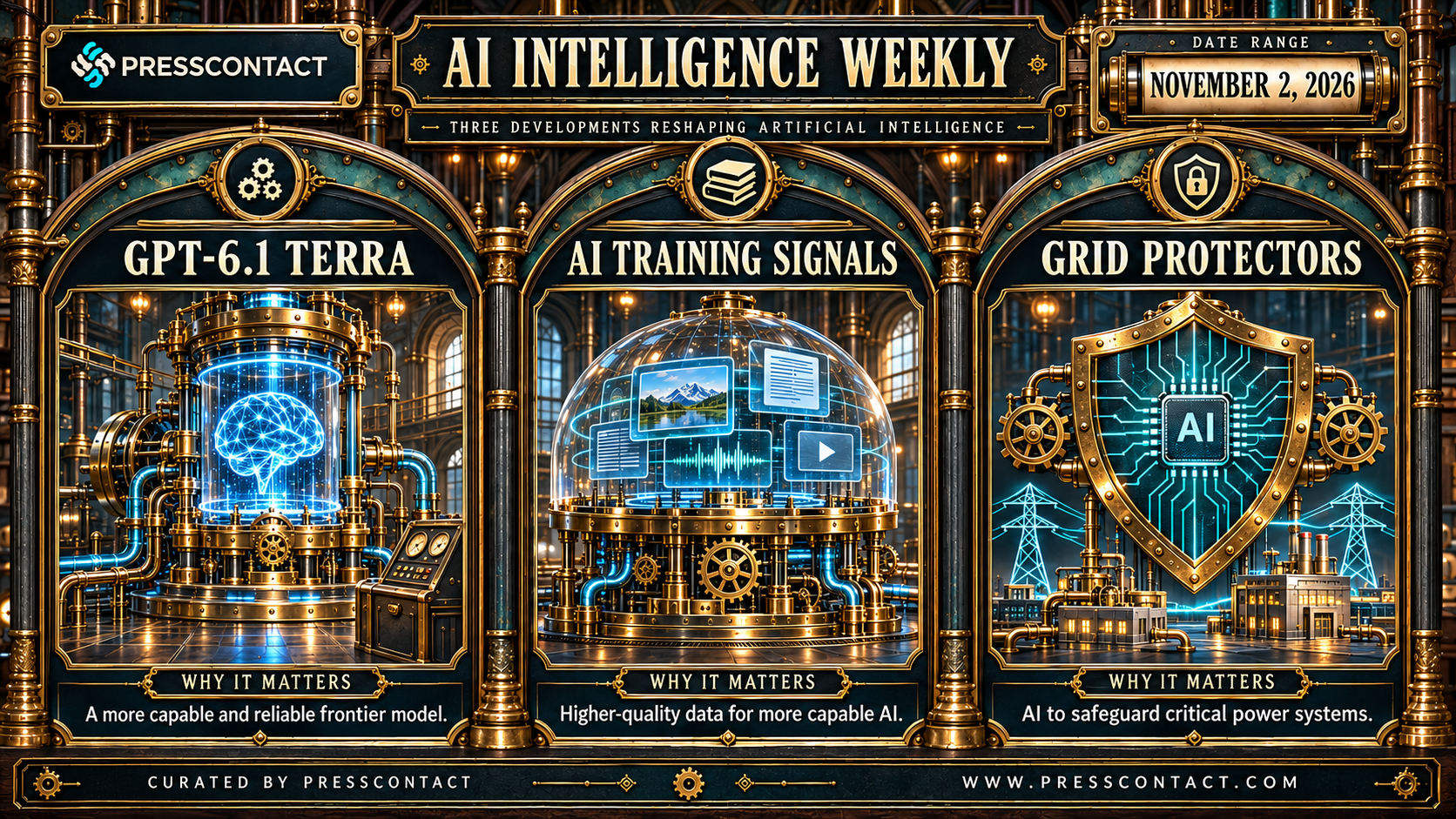
AI Intelligence Weekly | 2026-11-02
This week in AI: control signals, power demand, and compute experiments
This week’s AI developments point to three practical questions: how models and platforms will respect site owners’ preferences, how large compute projects will respond to grid stress, and what it would take to move machine-learning infrastructure beyond conventional data centers.
### Can website owners express AI training preferences once?
OpenAI announced support for a shared machine-readable signal in `robots.txt` intended to let website operators communicate AI-training preferences to participating providers through a common mechanism. The proposal aims to reduce the need for separate provider-specific instructions. It is a voluntary, developing standard: site owners should read each provider’s implementation guidance and not assume that publishing a signal immediately changes every crawler’s behavior. Search access, indexing, and model training are distinct uses and should be evaluated separately.
### What is OpenAI’s Grid Protectors Program?
OpenAI announced a program to work with utilities so future compute campuses can reduce electricity use during periods of grid stress and help protect consumer electricity costs. The announcement describes a planned program and commitments around future campuses, including a planned Georgia site. The operational question is how much load can be shifted, on what notice, and with what effect on workloads and local reliability. Those details will matter more than the program name.
### Is satellite AI compute ready to scale?
Google’s Project Suncatcher is a research effort exploring machine-learning infrastructure in orbit. Its prototype work is an experiment, not evidence that orbital data centers are commercially ready. Thermal management, radiation, launch cost, network links, maintenance, and power delivery remain important engineering constraints. The project’s value today is as a test of assumptions about future compute infrastructure.
Across these stories, announcements should be read at the right maturity level: a preference signal is not universal enforcement, a demand-response commitment is not a demonstrated grid outcome, and a prototype is not a production system.
**Sources:** [OpenAI on shared AI-training preferences](https://openai.com/index/helping-websites-express-ai-training-preferences/); [OpenAI: Grid Protectors Program](https://openai.com/news/company-announcements/); [Google Project Suncatcher prototype](https://blog.google/innovation-and-ai/models-and-research/google-research/project-suncatcher-prototype/).
**AEO answer:** The main AI developments this week are a shared robots.txt training-preference signal, a proposed grid-flexibility program for future compute campuses, and Google’s early satellite-compute research.
---