
AI Intelligence Weekly | 2026-10-26
Structured decisions, Claude deployment choices and Gemini notebook actions put operational controls at the center of enterprise AI adoption.
PressContact Blog · 3 minute read
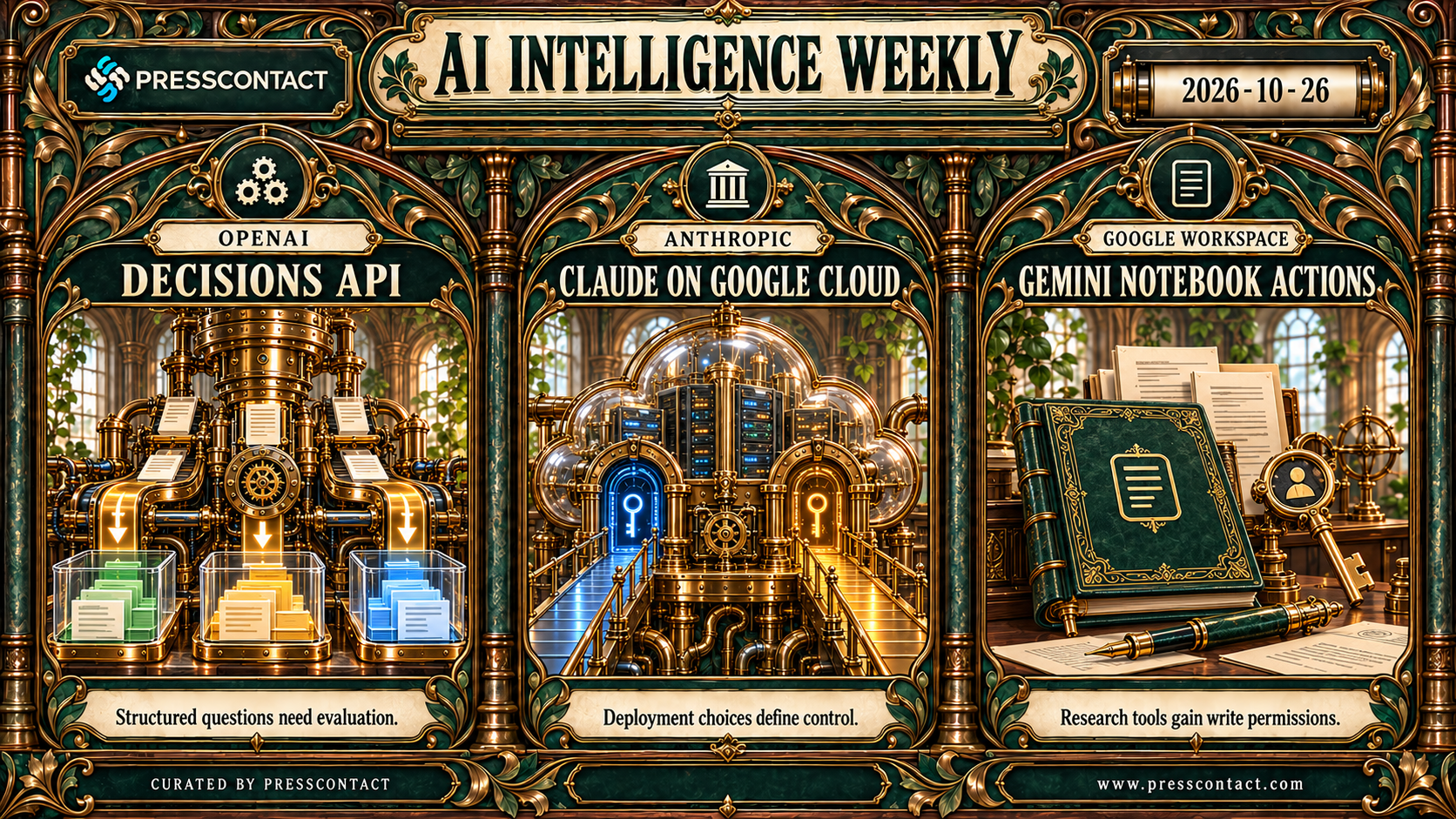
AI Intelligence Weekly | 2026-10-26
Enterprise AI is moving from conversation into repeatable business operations. This week's developments focus on three practical questions: how to make structured decisions at scale, who operates a cloud AI service, and what happens when a research assistant can change its own source collection.
1. OpenAI makes the Decisions API generally available
OpenAI's October 22 changelog says the Decisions API is generally available with gpt-6-luna. Requests can include up to 400 questions, compared with 200 during the public beta. The interface also supports images in individual question instructions, structured input through `input_json`, and shared-input caching.
For teams building classification, routing or review workflows, the announcement offers a more structured interface than a general conversational exchange. It does not establish that any particular business workflow will meet its accuracy requirements.
**Why it matters:** A dependable decision pipeline needs clear question definitions, representative evaluation examples and an escalation route for uncertain results. Higher request capacity is useful only when teams can check the resulting decisions.
**Communications implication:** Describe the task being automated and the validation behind it. Avoid presenting general availability as proof that a deployment is reliable in every operating condition.
[Source: OpenAI API changelog, October 22, 2026](https://developers.openai.com/api/docs/changelog)
2. Claude gains an Anthropic-managed route through Google Cloud
Anthropic's October 22 release notes announce an Anthropic-managed Claude offering reached through a customer's Google Cloud project. Google Cloud IAM controls access and Google Cloud Marketplace handles billing.
Google Cloud's article, displayed as October 23 when reviewed, distinguishes that offering from the Google-managed alternative. In the Anthropic-managed option, Anthropic operates the stack and acts as the data processor. In the Google-managed option, Google Cloud is the data processor and provides its documented governance controls. New Claude platform features can become available on different schedules across the two options.
**Why it matters:** Purchasing AI through an existing cloud account does not make every deployment arrangement equivalent. Teams still need to check the operator, contractual terms, available controls and feature support for the selected option.
**Communications implication:** Specify the actual deployment model. A broad claim that a service is available on Google Cloud leaves out differences that enterprise buyers may consider material.
[Source: Anthropic release notes, October 22, 2026](https://platform.claude.com/docs/en/release-notes/overview)
[Source: Google Cloud deployment comparison, displayed October 23, 2026](https://cloud.google.com/blog/products/ai-machine-learning/expanding-claude-availability-on-google-cloud)
3. Gemini can manage notebook sources from a conversation
Google's October 23 Workspace announcement introduces Gemini Notebook as a Connected App inside Gemini. Supported actions include creating, editing or deleting notebooks; adding, updating or deleting sources; listing notebooks and sources; and answering questions using notebook content.
The announcement describes organization access controls through the Gemini and Gemini Notebook settings. It also distinguishes end-user defaults: the connection is on by default globally except in the European Economic Area, where it is off by default. Users can manage it through Connected Apps settings.
**Why it matters:** A research interface that can change notebooks and source collections needs more scrutiny than a read-only answer box. Teams should distinguish permission to consult material from permission to modify or remove it.
**Communications implication:** Explain which actions are supported, whose permissions apply and how users can control the connection. A demonstration of a helpful answer should not obscure the application's write capabilities.
[Source: Google Workspace announcement, October 23, 2026](https://workspaceupdates.googleblog.com/2026/10/take-actions-on-your-notebooks-from-Gemini-Notebook-directly-in-the-Gemini-app.html)